Primary texts and readings:
Aguilar-Cariño, Maria Luisa B. “Firstborn.” The Likhaan Book of Poetry and Fiction 1995, edited by Gémino H. Abad and Cristina Pantoja Hidalgo , Likhaan, U.P. Creative Writing Center, College of Arts and University of the Philippines Press, Diliman, Quezon City, 1996, pp. 9–11.
Aguilar-Cariño, Ma. Luisa B. “The Secret Language.” Songs of Ourselves Writings by Filipino Women in English, edited by Edna Zapanta-Manlapaz, Anvil, Pasig, Metro Manila, 1996, pp. 297-298.
Alcantara-Dimalanta, Ophelia. “A Matter of Choice.” The Likhaan Book of Poetry and Fiction 1995, edited by Gémino H. Abad and Cristina Pantoja Hidalgo , Likhaan, U.P. Creative Writing Center, College of Arts and University of the Philippines Press, Diliman, Quezon City, 1996, pp. 14-16.
Ancheta, Shirley. “Triptych.” Baybaylan: An Anthology of Filipina and Filipina American Writers, edited by Nick Carbó and Eileen Tabios, Aunt Lute Books, San Francisco, California, 2000, pp. 178-180.
Alfon, Estrella. “Magnificence.” Songs of Ourselves Writings by Filipino Women in English, edited by Edna Zapanta-Manlapaz, Anvil, Pasig, Metro Manila, 1996, pp. 60-65.
Babst, Arlene P. “The Lesbian.” Being Filipino: Writings, edited by Gilda Cordero-Fernando, GCF Books, 1981, pp. 91-103.
Balmori, Jesus. “Crazy Souls.” Philippine Short Stories in Spanish: 1900-1941, edited by Pilar E Mariño, Office of Research Coordination, University of the Philippines, Quezon City, Philippines, 1989, pp. 56-59.
Balmori, Jesus. “Dream Country.” Philippine Short Stories in Spanish: 1900-1941, edited by Pilar E Mariño, Office of Research Coordination, University of the Philippines, Quezon City, Philippines, 1989, pp. 44-49.
Balmori, Jesus. “Redemption.” Philippine Short Stories in Spanish: 1900-1941, edited by Pilar E Mariño, Office of Research Coordination, University of the Philippines, Quezon City, Philippines, 1989, pp. 168-175.
Balmori, Jesus. “The Son.” Philippine Short Stories in Spanish: 1900-1941, edited by Pilar E Mariño, Office of Research Coordination, University of the Philippines, Quezon City, Philippines, 1989, pp. 348-353.
Bautista, Michelle Macareg. “In Whispers.” Going Home to a Landscape: Writings by Filipinas, edited by Marianne Villanueva and Virginia R. Cerenio, CALYX Books, Corvallis, Or., 2003, pp. 131-132.
Bobis, Merlinda C. “Mother’s Break.” Songs of Ourselves Writings by Filipino Women in English, edited by Edna Zapanta-Manlapaz, Anvil, Pasig, Metro Manila, 1996, pp. 284.
Bobis, Merlinda. “White Turtle.” Going Home to a Landscape: Writings by Filipinas, edited by Marianne Villanueva and Virginia R. Cerenio, CALYX Books, Corvallis, Or., 2003, pp. 99-110.
Bose, Lilledeshan. “The Star.” Baybaylan: An Anthology of Filipina and Filipina American Writers, edited by Nick Carbó and Eileen Tabios, Aunt Lute Books, San Francisco, California, 2000, pp. 31–42.
Brainard, Cecilia Manguerra. “Magdalena’s Monologue.” Baybaylan: An Anthology of Filipina and Filipina American Writers, edited by Nick Carbó and Eileen Tabios, Aunt Lute Books, San Francisco, California, 2000, pp. 43-45.
Brainard, Cecilia Manguerra. “Trinidad’s Brooch.” Songs of Ourselves Writings by Filipino Women in English, edited by Edna Zapanta-Manlapaz, Anvil, Pasig, Metro Manila, 1996, pp. 235-239.
Brainard, Cecilia Manguerra. “Vigan.” Going Home to a Landscape: Writings by Filipinas, edited by Marianne Villanueva and Virginia R. Cerenio, CALYX Books, Corvallis, Or., 2003, pp. 264-273.
Camacho, Justine U. “A Filipino Writer of English Poems to a Filipino Writers of Spanish Poems.” The Likhaan Book of Poetry and Fiction 1995, edited by Gémino H. Abad and Cristina Pantoja Hidalgo , Likhaan, U.P. Creative Writing Center, College of Arts and University of the Philippines Press, Diliman, Quezon City, 1996, pp. 31-32.
Cheng, Caroline. “Consolation.” Baybaylan: An Anthology of Filipina and Filipina American Writers, edited by Nick Carbó and Eileen Tabios, Aunt Lute Books, San Francisco, California, 2000, pp. 46-59.
Cordero-Fernando, Gilda. “People in the War.” Songs of Ourselves Writings by Filipino Women in English, edited by Edna Zapanta-Manlapaz, Anvil, Pasig, Metro Manila, 1996, pp. 66-77.
Cruz, Conchitina R. “Cartographer.” Going Home to a Landscape: Writings by Filipinas, edited by Marianne Villanueva and Virginia R. Cerenio, CALYX Books, Corvallis, Or., 2003, pp. 55.
Cruz, Conchitina R. “Daughter.” Going Home to a Landscape: Writings by Filipinas, edited by Marianne Villanueva and Virginia R. Cerenio, CALYX Books, Corvallis, Or., 2003, pp. 263.
Cruz, Conchitina R. “Roots.” Going Home to a Landscape: Writings by Filipinas, edited by Marianne Villanueva and Virginia R. Cerenio, CALYX Books, Corvallis, Or., 2003, pp. 261-262.
David, Mabi Perez. “Cloister.” Going Home to a Landscape: Writings by Filipinas, edited by Marianne Villanueva and Virginia R. Cerenio, CALYX Books, Corvallis, Or., 2003, pp.154.
D’Exploits, Emmanuel M. “Spirit and Matter.” Philippine Short Stories in Spanish: 1900-1941, edited by Pilar E Mariño, Office of Research Coordination, University of the Philippines, Quezon City, Philippines, 1989, pp. 354-363.
Espina-Moore, Lina. “Gift to the Earth.” Songs of Ourselves Writings by Filipino Women in English, edited by Edna Zapanta-Manlapaz, Anvil, Pasig, Metro Manila, 1996, pp. 107-119.
Evasco, Marjorie. “Dreamweavers.” Songs of Ourselves Writings by Filipino Women in English, edited by Edna Zapanta-Manlapaz, Anvil, Pasig, Metro Manila, 1996, pp. 240-241.
Evasco, Marjorie. “Mandarawak.” Songs of Ourselves Writings by Filipino Women in English, edited by Edna Zapanta-Manlapaz, Anvil, Pasig, Metro Manila, 1996, pp. 243-244.
Evasco, Marjorie. “Maria de las Flores.” Songs of Ourselves Writings by Filipino Women in English, edited by Edna Zapanta-Manlapaz, Anvil, Pasig, Metro Manila, 1996, pp. 252-253.
Evasco, Marjorie. “Sampaguita Song.” Songs of Ourselves Writings by Filipino Women in English, edited by Edna Zapanta-Manlapaz, Anvil, Pasig, Metro Manila, 1996, pp. 194-195.
Florentino, Leona. “Blasted Hopes .” Poemist, http://www.poemist.com/leona-florentino/blasted-hopes. Accessed 14 Aug. 2023.
Galang, Evelina M. “Drowning.” Baybaylan: An Anthology of Filipina and Filipina American Writers, edited by Nick Carbó and Eileen Tabios, Aunt Lute Books, San Francisco, California, 2000, pp. 60-70.
Guerrero-Zacarias, Evangelina E. “Tears.” Philippine Short Stories in Spanish: 1900-1941, edited by Pilar E Mariño, Office of Research Coordination, University of the Philippines, Quezon City, Philippines, 1989, pp. 244-249.
Guerrero, Fernando Ma. “María Clara.” Philippine Short Stories in Spanish: 1900-1941, edited by Pilar E Mariño, Office of Research Coordination, University of the Philippines, Quezon City, Philippines, 1989, pp. 32–35.
Guerrero, Fernando Ma. “The Wanderer.” Philippine Short Stories in Spanish: 1900-1941, edited by Pilar E Mariño, Office of Research Coordination, University of the Philippines, Quezon City, Philippines, 1989, pp. 232-235.
Guevara, Nerisa del Carmen. “Rosa.” The Likhaan Book of Poetry and Fiction 1995, edited by Gémino H. Abad and Cristina Pantoja Hidalgo , Likhaan, U.P. Creative Writing Center, College of Arts and University of the Philippines Press, Diliman, Quezon City, 1996, pp.185-189.
Hagedorn, Jessica. “Tenement Lover: no palm trees/in new york city.” Baybaylan: An Anthology of Filipina and Filipina American Writers, edited by Nick Carbó and Eileen Tabios, Aunt Lute Books, San Francisco, California, 2000, pp. 71-82.
Hernandez, Erna. “Tsismis.” Baybaylan: An Anthology of Filipina and Filipina American Writers, edited by Nick Carbó and Eileen Tabios, Aunt Lute Books, San Francisco, California, 2000, pp. 228-231.
Hollinsteiner, Mary Racelis. “The Wife.” Being Filipino: Writings, edited by Gilda Cordero-Fernando, GCF Books, 1981, pp. 37-53.
Lanot, Marra Pl. “Tribeswoman.” Songs of Ourselves Writings by Filipino Women in English, edited by Edna Zapanta-Manlapaz, Anvil, Pasig, Metro Manila, 1996, pp.196-197.
Lapuz, Lourdes V. “The Adolescent.” Being Filipino: Writings, edited by Gilda Cordero-Fernando, GCF Books, 1981, pp. 27-36.
Lapuz, Lourdes V. “The Mother.” Being Filipino: Writings, edited by Gilda Cordero-Fernando, GCF Books, 1981, pp 9-13.
Latorena , Paz. “The Small Key.” Songs of Ourselves Writings by Filipino Women in English, edited by Edna Zapanta-Manlapaz, Anvil, Pasig, Metro Manila, 1996, pp. 1–6.
Lim-Wilson, Fatima. “Broken English.” Baybaylan: An Anthology of Filipina and Filipina American Writers, edited by Nick Carbó and Eileen Tabios, Aunt Lute Books, San Francisco, California, 2000, pp. 244-245.
Lim, Fatima. “From the Forbidden Tree.” Songs of Ourselves Writings by Filipino Women in English, edited by Edna Zapanta-Manlapaz, Anvil, Pasig, Metro Manila, 1996, pp. 260-261.
Lim, Fatima. “Slave Woman of Tarlac, Tarlac.” Songs of Ourselves Writings by Filipino Women in English, edited by Edna Zapanta-Manlapaz, Anvil, Pasig, Metro Manila, 1996, pp. 258-259.
Luna, Antonio. “The Teacher of My Town.” Philippine Short Stories in Spanish: 1900-1941, edited by Pilar E Mariño, Office of Research Coordination, University of the Philippines, Quezon City, Philippines, 1989, pp. 224-231.
Mabalon, Dawn Bohulano. “For the Women.” Going Home to a Landscape: Writings by Filipinas, edited by Marianne Villanueva and Virginia R. Cerenio, CALYX Books, Corvallis, Or., 2003, pp. 22–25.
Martinez-Coscolluela, Elsa. “Katipunera.” The Likhaan Book of Poetry and Fiction 1995, edited by Gémino H. Abad and Cristina Pantoja Hidalgo , Likhaan, U.P. Creative Writing Center, College of Arts and University of the Philippines Press, Diliman, Quezon City, 1996, pp. 41-46.
Melvin, Reine Arache. “Homecoming.” Going Home to a Landscape: Writings by Filipinas, edited by Marianne Villanueva and Virginia R. Cerenio, CALYX Books, Corvallis, Or., 2003, pp. 58-70.
Mevin, Reine Arache. “The Birth.” Baybaylan: An Anthology of Filipina and Filipina American Writers, edited by Nick Carbó and Eileen Tabios, Aunt Lute Books, San Francisco, California, 2000, pp. 97-106.
Miraflor, Norma O. “Gypsies in My World.” The Likhaan Book of Poetry and Fiction 1995, edited by Gémino H. Abad and Cristina Pantoja Hidalgo , Likhaan, U.P. Creative Writing Center, College of Arts and University of the Philippines Press, Diliman, Quezon City, 1996, pp. 213-225.
Ng, Fran. “Notebook.” Going Home to a Landscape: Writings by Filipinas, edited by Marianne Villanueva and Virginia R. Cerenio, CALYX Books, Corvallis, Or., 2003, pp. 136.
Palma, Rafael. “New Heart.” Philippine Short Stories in Spanish: 1900-1941, edited by Pilar E Mariño, Office of Research Coordination, University of the Philippines, Quezon City, Philippines, 1989, pp. 14-17.
Remoto, Danton. “Woman of Many Voices.” The Likhaan Book of Poetry and Fiction 1995, edited by Gémino H. Abad and Cristina Pantoja Hidalgo , Likhaan, U.P. Creative Writing Center, College of Arts and University of the Philippines Press, Diliman, Quezon City, 1996, pp. 80-81.
Reyes, Barbara Jane. “Brown Girl Manifesto: #allpinayeverything .” Poetry Foundation, 2020, http://www.poetryfoundation.org/poems/154712/brown-girl-manifesto-allpinayeverything.
Reyes, Barbara Jane. “To Love as Aswang by Barbara Jane Reyes.” Poetry Foundation, http://www.poetryfoundation.org/poetrymagazine/poems/56952/to-love-as-aswang. Accessed 14 Aug. 2023.
Reyes, Barbara Jane. “To Be Walang Hiya by Barbara Jane Reyes.” Poetry Foundation, http://www.poetryfoundation.org/poetrymagazine/poems/56953/to-be-walang-hiya. Accessed 14 Aug. 2023.
Rivera-Ford, Aida. “The Chieftest Mourner.” Songs of Ourselves Writings by Filipino Women in English, edited by Edna Zapanta-Manlapaz, Anvil, Pasig, Metro Manila, 1996, pp. 47-53.
Rivera-Gravage, Michelle. “I am Now the Chaste Specter.” Baybaylan: An Anthology of Filipina and Filipina American Writers, edited by Nick Carbó and Eileen Tabios, Aunt Lute Books, San Francisco, California, 2000, pp. 264.
Roces, Sixto. “The Wench.” Philippine Short Stories in Spanish: 1900-1941, edited by Pilar E Mariño, Office of Research Coordination, University of the Philippines, Quezon City, Philippines, 1989, pp. 60-65.
Rodriguez, Buenaventura. “Feast of Death.” Philippine Short Stories in Spanish: 1900-1941, edited by Pilar E Mariño, Office of Research Coordination, University of the Philippines, Quezon City, Philippines, 1989, pp. 94-103.
Rodriguez, Francisco. “Sublime Abjection.” Philippine Short Stories in Spanish: 1900-1941, edited by Pilar E Mariño, Office of Research Coordination, University of the Philippines, Quezon City, Philippines, 1989, pp.156-161.
Rodriguez, Nice. “When You’re Six.” Songs of Ourselves Writings by Filipino Women in English, edited by Edna Zapanta-Manlapaz, Anvil, Pasig, Metro Manila, 1996, pp. 366-370.
Santiago, Carmen Enrile. “The Child.” Being Filipino: Writings, edited by Gilda Cordero-Fernando, GCF Books, 1981, pp. 19-26.
Santiago, Carmen Enrile. “The Lover and the Mistress.” Being Filipino: Writings, edited by Gilda Cordero-Fernando, GCF Books, 1981, pp. 60-77.
Skinner, Michelle Cruz. “Simbang Gabi.” Songs of Ourselves Writings by Filipino Women in English, edited by Edna Zapanta-Manlapaz, Anvil, Pasig, Metro Manila, 1996, pp. 265-277.
Talusan, Grace. “Smoky Mountain.” Going Home to a Landscape: Writings by Filipinas, edited by Marianne Villanueva and Virginia R. Cerenio, CALYX Books, Corvallis, Or., 2003, pp. 220-226.
Tarrosa-Subido, Trinidad. “Vanity.” Songs of Ourselves Writings by Filipino Women in English, edited by Edna Zapanta-Manlapaz, Anvil, Pasig, Metro Manila, 1996, pp. 7.
Tarrosa-Subido, Trinidad. “Poem to the Other Woman.” Songs of Ourselves Writings by Filipino Women in English, edited by Edna Zapanta-Manlapaz, Anvil, Pasig, Metro Manila, 1996, pp. 36.
Tiongson, Nicanor G. “The Old Maid.” Being Filipino: Writings, edited by Gilda Cordero-Fernando, GCF Books, 1981, pp. 137-146.
Tirol, Lorna Kalaw. “The Widow.” Being Filipino: Writings, edited by Gilda Cordero-Fernando, GCF Books, 1981, pp. 147-155.
Ty-Casper, Linda. “The Outside Heart.” Songs of Ourselves Writings by Filipino Women in English, edited by Edna Zapanta-Manlapaz, Anvil, Pasig, Metro Manila, 1996, pp. 87-97.
Ventura, Sylvia Mendez. “The Child of Separation.” Being Filipino: Writings, edited by Gilda Cordero-Fernando, GCF Books, 1981, pp. 125-136.
Ventura, Sylvia Mendez. “The Ex-Wife.” Being Filipino: Writings, edited by Gilda Cordero-Fernando, GCF Books, 1981, pp. 104-115.Vidal, Lourdes H. “Virgin.” Songs of Ourselves Writings by Filipino Women in English, edited by Edna Zapanta-Manlapaz, Anvil, Pasig, Metro Manila, 1996, pp. 328.
Secondary Sources:
Abad, Michelle. “1 out of 5 Filipinos Aspires to Live Abroad – SWS Survey.” RAPPLER, 21 Apr. 2023, http://www.rappler.com/nation/filipinos-aspire-live-abroad-sws-survey-december-2022/.
Abjelina, AA. “I Am #magandangmorenx: Loud, Brown, and Proudly Filipina.” Cambio & Co., 19 Apr. 2023, http://www.shopcambio.co/blogs/news/i-am-magandangmorenx-loud-brown-and-proudly-filipina.
Ashliman, D.L. “Creation Myths from the Philippines.” Creation Myths from the Philippines, 8 Jan. 2003, sites.pitt.edu/~dash/creation-phil.html.
Asis, Zea. “Why It’s Time to Rewrite María Clara & Our Filipina Story.” Cambio & Co., http://www.shopcambio.co/blogs/news/why-it-s-time-to-rewrite-maria-clara-our-filipina-story. Accessed 14 Aug. 2023.
Altbach, Philip. “Literary Colonialism: Books in the Third World.” Harvard Educational Review, vol. 45, no. 2, 1975, pp. 226–236, https://doi.org/10.17763/haer.45.2.f2p87v8h618322m2.
Altin, Asli Degrimenci. “Postcolonial Literature and Ecofeminism.” The Routledge Handbook of Ecofeminism and Literature, edited by Douglas A. Vakoch, 1st ed., Routledge, Abingdon, Oxon, 2023.
Bernstein, Isabella Garcia, and Jackie Mariano. “PINANGGALINGAN: Remembering Our Roots.” Kabataan Alliance, Roots of Migration, 2023, pp. 11–17.
Butler , Judith. “Gender as Performance .” A Critical Sense , 1st ed., Routledge , 1996.
Blanco, John D. “Race as Praxis in the Philippines at the Turn of the Twentieth Century.” Colonial Philippines in Transition, vol. 49, no. 3, 2011, pp. 356–394, https://doi.org/10.20495/tak.49.3_356.
Blumentritt, Mia. “Bontoc Eulogy, History, and the Craft of Memory: An Extended Conversation with Marlon E. Fuentes.” Amerasia Journal, vol. 24, no. 3, 13 Feb. 2019, pp. 75–90. Taylor & Francis Online , https://doi.org/10.17953/amer.24.3.g21132m73h587383.
Call Her Ganda, http://www.callherganda.com/. Accessed 14 Aug. 2023.
Cauguiran, Cate. “Filipino Nurses in America: The Unseen, Unsung, Untold Story.” ABC7 Chicago, 2 June 2022, abc7chicago.com/filipino-nurse-nurses-in-america-history-stereotype/11913667/.
“Catholicism in the Philippines.” Religion and Public Life at Harvard Divinity School, rpl.hds.harvard.edu/faq/catholicism-philippines. Accessed 14 Aug. 2023.
Cervantes, Carl Lorenz, et al. “The Aswang Project.” THE ASWANG PROJECT, 6 June 2023, http://www.aswangproject.com/.
Constante, Agnes. “Filipino American Culture and Catholicism Are Interconnected. How That Affects Mental Health.” Los Angeles Times, 20 Oct. 2022, http://www.latimes.com/lifestyle/story/2022-10-20/filipino-american-mental-health-catholicism-story#:~:text=Catholicism%20practiced%20by%20Filipinos%20today,Jesus%20Christ%20on%20Easter%20morning.
De León, Gerardo, director. Noli Me Tángere. YouTube, YouTube, 2 Jan. 2015, https://www.youtube.com/watch?v=bBJW1NRCD1g&t=1423s. Accessed 14 Aug. 2023.
Flores, Penelope V, et al. “Why ‘white Is Beautiful’ among Filipinos .” Positively Filipino | Online Magazine for Filipinos in the Diaspora, 6 Apr. 2022, http://www.positivelyfilipino.com/magazine/why-white-is-beautiful-among-filipinos.
“Filipino Women Migrant Workers Fact Sheet.” UN Women – Headquarters, 2016, http://www.unwomen.org/en/digital-library/publications/2016/6/filipino-women-migrant-workers-fact-sheet.
“Gabriela – National Alliance of Filipino Women Southeast Asia – Philippines, Indonesia, Thailand, Vietnam, Singapore, Malaysia, Cambodia, Laos – One Billion Rising Revolution.” One Billion Rising Revolution – The Biggest Mass Global Action To End Violence Against Women & Girls In The History Of Humankind, 14 Feb. 2023, http://www.onebillionrising.org/41139/gabriela-national-alliance-of-filipino-women-southeast-asia-philippines-indonesia-thailand-vietnam-singapore-malaysia-cambodia-laos/#:~:text=GABRIELA%20is%20a%20grassroots%2Dbased,countries%20outside%20of%20the%20Philippines.
Gebreyohannes, Nigus Michael, and Abiye Daniel David. “Women and Nature: An Ecofeminist Reading of Chimamanda Ngozi Adichie’s Purple Hibiscus.” Literature, vol. 2, no. 3, 1 Sept. 2022, pp. 179–188, https://doi.org/10.3390/literature2030015.
Gurung , Ivy Angelie P. THE CURSE OF THE MODERN FILIPINA: EXPOSING THE SATIRICAL REPRESENTATION OF THE WOMEN IN JOSE RIZAL’S NOLI ME TANGERE TO SAVE THE MARIA CLARA, SISA AND DOÑA VICTORINA OF TODAY, The Education University of Hong Kong, The Education University of Hong Kong, May 2018, https://www.lib.eduhk.hk/pure-data/pub/201809325/201809325_1.pdf. Accessed 14 Aug. 2023.
Hau, Caroline S. “The Afterlives of María Clara.” Humanities Diliman: A Philippine Journal of Humanities, vol. 18, no. 1, 29 June 2021, pp. 118–161, https://journals.upd.edu.ph/index.php/humanitiesdiliman/article/view/7729.
Hega, Mylene D, et al. Feminism and the Women’s Movement in the Philippines: Struggles, Advances, and Challenges , Friedrich Ebert Stiftung , Manila, 2017.
Hoh, Anchi. “Catholicism in the Philippines during the Spanish Colonial Period 1521-1898.” The Library of Congress, 10 July 2018, blogs.loc.gov/international-collections/2018/07/catholicism-in-the-philippines-during-the-spanish-colonial-period-1521-1898/.
Ileto, Reynaldo Clemena. “Philippine Wars and the Politics of Memory.” positions: east asia cultures critique, vol. 13 no. 1, 2005, p. 215-235. Project MUSE muse.jhu.edu/article/185290.
Jiao, Min. Mothering and Motherhood: Experience, Ideology, and Agency. Comparative Literature Studies, vol. 56, no. 3, 15 September 2019, pp. 541–556. doi: https://doi.org/10.5325/complitstudies.56.3.0541
KATIGBAK, Meggy. “[Opinion] the Feminist Movement: Love Manifesting through Collective Struggle.” RAPPLER, 7 Mar. 2023, http://www.rappler.com/voices/ispeak/opinion-feminist-movement-love-manifesting-through-collective-struggle/.
“Labour Migration in the Philippines (ILO in the Philippines).” International Labour Organization, http://www.ilo.org/manila/areasofwork/labour-migration/lang–en/index.htm#:~:text=Globally%2C%20more%20people%20than%20ever,each%20year%20to%20work%20abroad. Accessed 14 Aug. 2023.
Lebsack, Lexy, director. Why People Risk Their Lives To Bleach Their Skin | Refinery 29. YouTube, YouTube, 25 May 2019, https://www.youtube.com/watch?v=hYTIh2cXfvM. Accessed 14 Aug. 2023.
“#MAGANDANGMORENX: Celebrating the Diversity of Filipino Beauty.” ASIA JACKSON, http://www.asiajackson.com/magandang-morenx. Accessed 14 Aug. 2023.
Martin, J. S. “The vernacular as method for memory and time: A philological and cultural exploration of Filipino concepts for Memory Studies.” Memory Studies, no. 13, vol 5, 2020, pp. 833–847. https://doi.org/10.1177/1750698020944978
Medalla, Emlyn Dy-cok. “Made for Export: How U.S. and Philippine Policies Commodify and Traffick Filipino Nurses .” City University of New York Law Review , vol. 26, no. 1, winter 2023, pp. 140–170, https://academicworks.cuny.edu/cgi/viewcontent.cgi?article=1560&context=clr.
Ocampo, Darrel M. “The Modern Filipina Archetypes and Ambiguities in the Wildflower Teleserye Vis-à-Vis Filipinos’ Sensibilities.” American Journal of Development Studies, vol. 1, no. 1, 16 Apr. 2023, pp. 10–15, https://doi.org/10.54536/ajds.v1i1.1511.
“Postcolonial Ecofeminism.” Postcolonial Ecofeminism | The Consortium on Gender, Security and Human Rights, genderandsecurity.org/keywords/postcolonial-ecofeminism. Accessed 14 Aug. 2023.
Rafael, Vicente L. “Linguistic Currencies: The Translative Power of English in Southeast Asia and the United States.” The Translator, vol. 25, no. 2, 28 Aug. 2019, pp. 142–158, https://doi.org/10.1080/13556509.2019.1654061.
Rafael, Vicente L. Motherless Tongues: The Insurgency of Language amid Wars of Translation. Duke University Press, 2016.
Rafael, Vicente L. “Nationalism, Imagery, and the Filipino Intelligentsia in the Nineteenth Century.” Critical Inquiry, vol. 16, no. 3, spring 1990, pp. 591–611, https://doi.org/10.1086/448548.
Rizal, Jose. Social Cancer. Translated by Charles E. Derbyshire , THE SOCIAL CANCER: A COMPLETE ENGLISH VERSION OF NOLI ME TANGERE, Project Gutenberg Literary Archive Foundation, 2006, The Project Gutenberg eBook of The Social Cancer: A Complete English Version of Noli Me Tangere, https://www.gutenberg.org/cache/epub/6737/pg6737-images.html, Accessed 14 Aug. 2023.
Roces, Mina. Women’s Movements and “the Filipina”: 1986-2008. University of Hawai’i Press, 2012. JSTOR, http://www.jstor.org/stable/j.ctt6wqd98. Accessed 15 Aug. 2023.
Salazar, Z. A. “The Exile in Philippine History.” Asian and Pacific Migration Journal, vol. 8, no. 1–2, 1999, pp. 19–64. https://doi.org/10.1177/011719689900800103
Sanchez, L.J.A. “The Teleserye Story: Three Periods of the Evolution of the Filipino TV Soap Opera.” Rupkatha Journal, vol. 14, no. 1, 2022, pp. 1-16. https://doi.org/10.21659/rupkatha.v14n1.13
Santos, Ana P. “Philippines: A History of Migration.” Pulitzer Center, 11 July 2014, pulitzercenter.org/stories/philippines-history-migration.
Serafica, Raisa Marielle. “In Defense of the Mistress.” RAPPLER, 26 Feb. 2015, http://www.rappler.com/voices/imho/84982-defense-mistress/.
The Bedford Glossary of Critical and Literary Terms. “Archetype (Defined).” Definition of “Archetype,” www2.hawaii.edu/~davink/MYTHOLOGY%20CLASS/DEFINITIONS/archetype.html. Accessed 14 Aug. 2023.
“The Filipino Diaspora in the United States .” Migrant Policy Institute- RAD Diaspora Profile, July 2014, http://www.migrationpolicy.org/sites/default/files/publications/RAD-PhilippinesII.pdf.
Toda, Monique. “From ‘Maria Clara’ to ‘Filipina Presidents’: The Achievements of the Filipino Woman.” Tatler Asia, 4 Apr. 2022, http://www.tatlerasia.com/power-purpose/ideas-education/the-evolution-of-maria-clara.
“What’s The Ideal Beauty Standard In The Philippines? | ASIAN BOSS.” YouTube, YouTube, 25 Oct. 2018, https://www.youtube.com/watch?v=6d1wP4n1Fxc. Accessed 14 Aug. 2023.
Winkelmann, Marie T. Dangerous Intercourse: Race, Gender and Interracial Relations in the American Colonial Philippines, 1898 – 1946, University of Illinois at Urbana-Champaign, University of Illinois at Urbana-Champaign, 24 Apr. 2015, https://hdl.handle.net/2142/78757. Accessed 14 Aug. 2023.
“Women’s RightsMovement of the Philippines.” Women’s Rights Movement of the Philippines, womenalliance.org/old/associate/wrmp.html. Accessed 14 Aug. 2023.
Xu, Donnalyn. Echoes of Maria Clara: Memory, (Im)Materiality, and Poetics in Filipino Dress, The University of Sydney, The University of Sydney, 23 May 2022, https://hdl.handle.net/2123/28619. Accessed 14 Aug. 2023.
Yeung, Jessie, and Xyza Cruz Bacani. “When Love Is Not Enough.” CNN, 2020, http://www.cnn.com/interactive/2020/11/asia/hong-kong-filipino-helpers-dst/.
Zapata, K. (2021, April 24). Why some Filipinos lighten their skin, some don’t, and it can be difficult to talk about | CBC news. CBCnews. https://www.cbc.ca/news/canada/calgary/filipino-calgary-skin-lightening-karina-zapata-1.5908655 ZAPANTA-MANLAPAZ, EDNA, and RUTH B. CUDALA. “Wrestling with Maria Clara: Filipino Women Poets in English, 1905-50.” Philippine Studies, vol. 38, no. 3, 1990, pp. 316–32. JSTOR, http://www.jstor.org/stable/42633193. Accessed 14 Aug. 2023.
Images:
Images on Home Page:
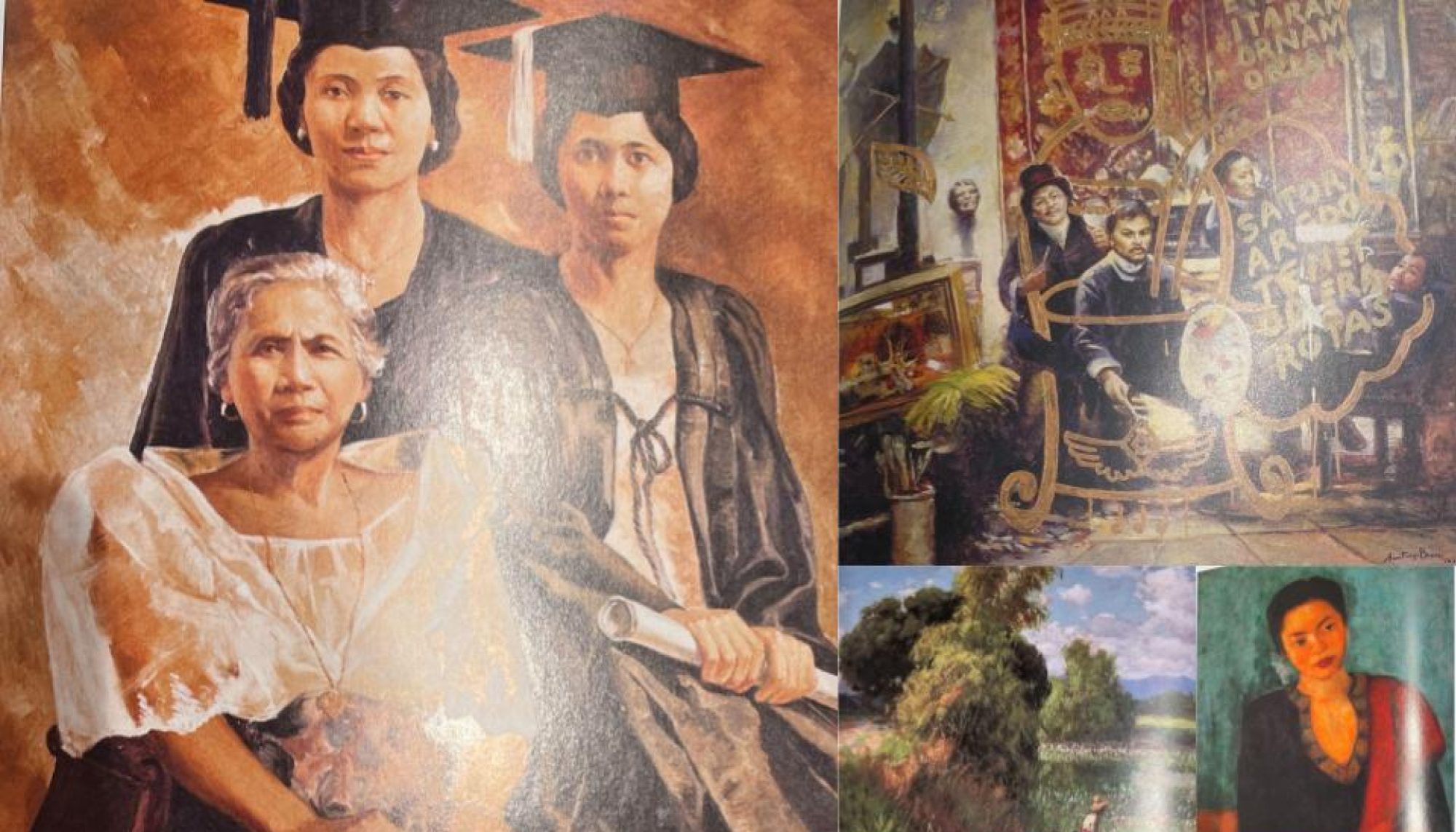
Bose, Santiago. Remapping the Colonised Subject. 1996. Singapore Art Museum Collection, Singapore.
Edades, Victorio. Moro Girl. 1950. Del Monte Collection, California, United States of America.
Landscape (Man Atop Carabao). 1936. Ayala Museum Collection, Manila, Philippines.
Puruganan, Ricarte. Graduation. 1935, Metropolitan Museum of Manila, Manila, Philippines.
Images on Makings of the Filipina: Representations of Womxn in Philippine Literature
Cariño, E. Aguilar. Posing in three’s for a picture wasn’t lucky – one would die. Everybody looked at the camera. Being Filipino: Writings, GCF Books, 1981.
Cariño, E. Aguilar. Nobody smiled. The shutter speed was very slow. No one could keep a smile that long. Being Filipino: Writings, GCF Books, 1981.
Ricio, Nik and Pablo Santos Mataquin. Tomboy years are those of adolescence when, closeted in a convent school environment, girls have crushes on each other. Butch, as she is called, and the exy check have a private gentle moment on the shady sidewalk. Being Filipino: Writings, GCF Books, 1981.
Ocampo, Galo. Nativity, C. Late-1930s. UST Museum Visual Arts Collection, Manila, Philippines.
Images on Archetypes Page:
Bencab. This portrait shows Inay as thoroughly dependable, a cook and homemaker, patient, hardworking and thrifty (she often has to make ends meet.) She never questions the decisions of her strong-willed husband. TO the children who are now all grown up and married she is still Mother of Perpetual Help. . Being Filipino: Writings, GCF Books, 1981, Being Filipino: Writings, p. 2.
Bencab. The Filipino wife carries her child around like a trophy. She cannot stand to hear him crying. SHe will pick him up at the slightest whimper and carry him along straddled on her hip as she goes about the neighborhood. (No wonder some Filipino kids end up bow-legged.) Being Filipino: Writings, GCF Books, 1981, Being Filipino: Writings, p. 4.
Bencab. The widow struggles to raise her children by herself with hard work and the meager pension of her deceased husband. Her victory is when they graduate. The person’s body seems to have forgotten what it is to love but then the church and religion have provided her a substitute security blanket. Being Filipino: Writings, GCF Books, 1981, Being Filipino: Writings, p. 5.
Bencab. The colegiala of old was told that it was a sin to use highly shined shoes as they would reflect what was under her skirt. Not quite so misguided, today’s colegiala is still shockable and excitable – an innocent waiting to be led astray. Being Filipino: Writings, GCF Books, 1981, Being Filipino: Writings, p. 6.
Bencab.The spinster stays with her family for whom she does maid work without pay. She is sometimes sweet hence she becomes the confidante of her nieces, and sometimes cranky (going into a tantrum over the leftover food disappearing from the refrigerator.) Being Filipino: Writings, GCF Books, 1981, Being Filipino: Writings, p. 8.
Bencab. The mistress with all her rings likes to look flashy and cared for even if she only lives in a rented apartment. Note her skirt blowing about in a carefree manner – she has no hang-ups, she is open to experience. In a confrontation with the wife this mistress would be defiant. Being Filipino: Writings, GCF Books, 1981, Being Filipino: Writings, p.10.
Bencab.The tomboy, because she has not had the share of acceptance and publicity that the gay enjoys, is less exhibitionistic. T-birds have no special lingo. Not yet quite out of the closet, they are often undetectable. Many tomboys imitate the strong silent macho types of men. Being Filipino: Writings, GCF Books, 1981, Being Filipino: Writings, p. 12.
Images on the Model of Maria Clara
Rizal Library. “Image of the Title Page of Jose Rizal’s Noli Me Tangere.” Rizal Library, Ateneo de Manila University , 10 Aug. 2018, http://rizal.library.ateneo.edu/node/811. Accessed 14 Aug. 2023.
Cariño, E. Aguilar. A Ryling, Muchas felicidades y largos años de vida, tus amigos, Inday, Nena, Lourding Cheding, Ita. Being Filipino: Writings, GCF Books, 1981.
Images on Mother Earth and the Nature of Womanhood
Winnowing Rice. 1949. Gift of Paz Zamora de Mascuña.
Images on Religion and Morality
Amorsolo, Fernando. Maid of Bataan. 1947, Del Monte Collection, California, United States of America.
Images on Motherhood
Cariño, E. Aguilar. Motherhood to the Filipino is a full-time, lifelong job for which she deserves a photograph. From here, she will raise the child practically alone. Being Filipino: Writings, GCF Books, 1981.
Images on Marriage
Cariño, E. Aguilar. The Filipino father is not usually concerned with the routine details of child rearing. But the birth of a child is important to his masculinity. Being Filipino: Writings, GCF Books, 1981.
Images on the Performance of Gender
Amorsolo, Fernando. Portrait of Fernanda de Jesus. 1915. Joselito D.Y. Campos, Jr. and Jeffrey D.Y. Campos Collection.
Cariño, E. Aguilar. First Communion pictures were important for giving away to relatives and to classmates. Many children posed in clothes that were not their own. Shoes belonged to an older sister or to the studio and were much too big. Being Filipino: Writings, GCF Books, 1981.
CC, JE. List: Top 21 Longest Running Kapamilya Weekday Series, April 11, 2021.
Images on Race, Class, and Colonial Dynamics
Bose, Santiago. Carnivores on Session Road. 2002. Esther and Biddy Que Collection.
 Paglaban Pilipino Literature Project